Waldorf News
What Happens When We Replace Images With Words?
August 4, 2026
“Stand straight as a spear, Class 1” Just that, nothing else. Then I wait. I have used this line since I first started teaching. It is simple, clear and the image is taken on by the children instantly. Within moments each child is standing straight and still. This is the power of an image. However, there is an ever increasing trend happening in Waldorf classrooms across the globe. The image is being replaced with a story. I have seen it in classrooms, heard it discussed by teachers and seen posts on social media asking for the perfect story for some activity or action the teacher needs. What sounds more Waldorf than a good story, a creative verbal imagination to engage the children and tap into their core learning capacity? But when we go into the classrooms something feels off. It feels nice but it’s not achieving what is needed. In the classroom there is often a story for everything now. Not long or in depth but a small story is used for a wide variety of activities. A story for line up, a story for sitting still, a story for painting, a story for many activities. Teachers collect and keep stories in various places from their training courses, colleagues and online. I have seen some beautifully crafted books in meticulous handwriting documenting stories for almost every conceivable activity in class. On the whole these stories are often beautifully crafted, imaginative and truly hold the children’s imagination. I love a story as much as any other teacher. But do we need so many? Has something been lost along the way? More »
Head, Heart, and Hand
July 20, 2026
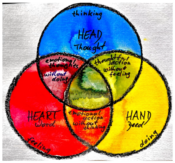
Every human being thinks. Every human being feels. Every human being acts. These are not three separate faculties accidentally housed in one body. They are three dimensions of a single life, as inseparable as length, width, and depth. Waldorf education builds its entire method on this insight that educating a child means cultivating all three capacities in the right order, at the right time, and through the right activities. The image is ancient. The medieval thinker spoke of ratio, affectus, and voluntas. Rudolf Steiner, the founder of the first Waldorf School in 1919, named them Thinking, Feeling, and Willing and placed them at the center of Waldorf Education. But the insight extends far beyond the classroom. It is a map of the human soul itself. More »
A Child Can Use a Phone. But Can She or He Tie a Knot?
July 13, 2026
As teachers and parents, we all know the skill and confidence with which a child can do things on a phone or iPad. Frankly, it puts most of us to shame. Yet these same children can hesitate or need support to tie a knot, hold a ruler or thread a needle. For many of us, these were skills we learnt early on. Now they are less necessary. Children have shoes without laces. They copy and paste material on a screen. So much arrives ready-made. Children are less often exposed to the fine-motor skills that many of us developed when we were young. They may not be asked to cut out a shape accurately, measure something carefully with a ruler or learn to knit or sew. This is not a case for every child to become “crafty”. It is a deeper question about what children are now bypassing because of the changing world they live in. When they are presented with these tasks, many have little confidence and, in some cases, not yet the fine-motor control to complete them. But something bigger is at stake. Children are also building a relationship with difficulty and with the process of learning a skill. All too often, the task is abandoned because it is too difficult or boring. There is no accomplishment because there has been no time to work through the difficulty. More »
Healing Presentiments of Spirit and Soul
June 30, 2026
Throughout civilizations, the telling of wisdom tales creates a sacred space between storyteller and listener. These stories, often of ageless origin, have changed and evolved over thousands of years, with universal truths revealed in soul archetypes that have inspired potential within humanity, weaving a thread of moral teaching from generation to generation. Fairytales are heavily shrouded within misty veils of dream consciousness, and while the analytical mind may get itself into trouble by interpreting archetype for stereotype, the consciousness of the young child is well met by the mystery that unfolds within. Essentially, these tales explore what it means to be human. A journey of individual destiny lies before the hero. More »
And What If Life Came from the Stars?
June 22, 2026
One of my main areas of research is chronobiology, the study of rhythms, but also cosmic chronobiology, that is, the study not only of earthly rhythms but also of all cosmic rhythms. There are no purely earthly rhythms. The sun always plays a role, as does the moon and so on. This interest comes from my family. My grandfather had a beautiful farm in Switzerland. He ran an exemplary agricultural enterprise where people were happy and the business was profitable. He took the phases of the moon into account. Yet there was little objective evidence based on standard scientific methods to show that this actually works. I learned that biodynamics uses lunar rhythms. That made me wonder. I looked in books on biology and plant physiology. The moon wasn’t mentioned at all. But all traditions speak of it. More »
 Recent Jobs
View more jobs »
 Newsletter Archive
 Join the Mailing List!
Stay Connected…
Each week receive the Waldorf News Weekly Update, full of news, events, and more. Keep abreast of what's happening with Waldorf education.
 Add a Job Listing


 RSS Feeds